
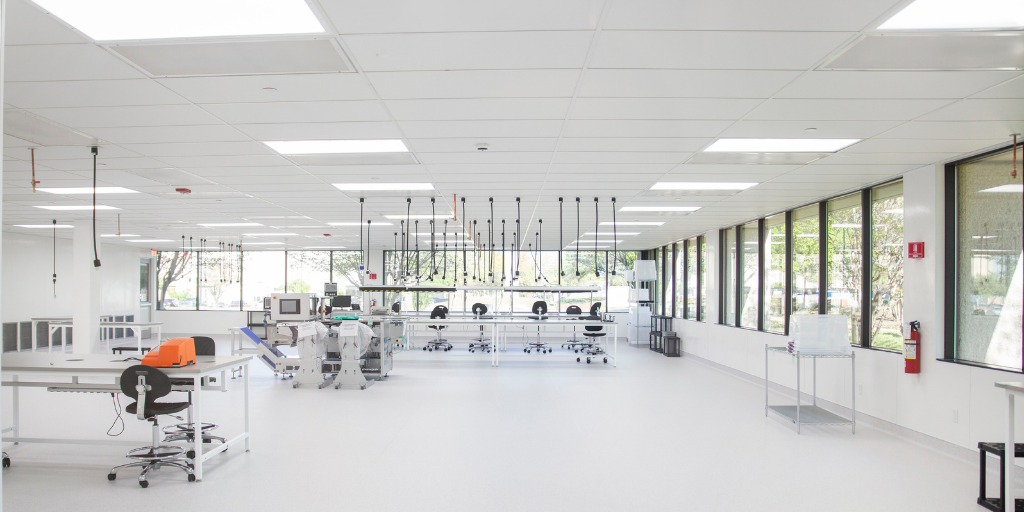
In regulated research and manufacturing environments, safety and compliance are shaped long before a cleanroom space or a lab becomes operational. Decisions about airflow, room adjacencies, material flow, and surface finishes directly affect contamination control, workflow efficiency, and regulatory readiness.
For organizations scaling research, manufacturing, or product development in controlled environments, facility design can directly influence risk, productivity, and audit outcomes. In many cases, the most important decisions occur during early planning, when teams map material flow, evaluate infrastructure, and document the rationale behind key design choices.
That was the reality for OriGen Biomedical (OriGen), a manufacturer serving the rapidly expanding cell and gene therapy sector, when the company planned its new Austin, Texas-area facility. After years of operating in a cleanroom environment constructed in 2010, the team had a clear understanding of what worked, what created operational friction, and what needed to change. Working alongside design partner S. Tipton Studio and engineering consultants, OriGen used those lessons to rethink the facility design so it better aligned with long-term manufacturing, safety, and compliance requirements.
Start with flow, not finishes
A cleanroom rarely functions as an isolated environment. Its performance depends just as much on the surrounding support spaces as on the controlled room itself.
One of the clearest lessons from the previous facility involved the separation of cleanrooms across the building. That arrangement created inefficiencies, including duplicated support spaces and longer travel paths for operators moving between controlled environments. These issues often emerge gradually as organizations expand into additional space or adapt layouts that were not originally designed for controlled manufacturing.
Support spaces such as gowning rooms and material entry rooms should be considered alongside the cleanroom itself. Personnel and materials need separate paths to support both contamination control and efficient workflow. When those support spaces are duplicated unnecessarily or placed too far from production areas, operators can lose significant time exiting controlled environments, re-gowning, and reentering adjacent rooms.
In the new facility, the cleanrooms are located side by side and organized around shared support spaces, reducing unnecessary movement and limiting the number of transitions required during production.
Material flow requires the same level of attention. In regulated manufacturing environments, it is not enough for materials to reach the cleanroom eventually. The route they take matters. Raw materials, work-in-progress, and finished goods should move through clearly defined paths that prevent sterile and nonsterile materials from crossing.
Mapping these routes early helps identify bottlenecks and reduce the number of handling steps required during production. Each unnecessary movement does not just reduce efficiency; it also introduces additional risk, especially in environments where contamination control is critical.
Airflow decisions affect more than airflow
Cleanroom performance is closely tied to airflow, pressure stability, and filtration efficiency. Spatial planning and mechanical system design need to happen together, not sequentially.
In the earlier cleanrooms at OriGen’s previous facility, ceilings were approximately 14 feet high. While that created a more open feel, it also increased the air volume within the room and made it harder to maintain consistent positive pressure and target air change rates. In the new facility, lowering the ceiling height to 9 feet reduced the air volume by 35 percent and helped improve system performance while still maintaining a comfortable environment for operators.
Taller ceilings may seem beneficial from a user experience standpoint, but they also require HVAC systems to move a greater volume of air to achieve the same cleanliness classification. Reducing unnecessary air volume can make it easier to maintain pressure differentials and improve filtration efficiency.
Air return placement is another important consideration. Planning production lines before finalizing air return locations helps prevent conflicts between airflow and equipment layout. That sequencing matters. When airflow paths are obstructed or poorly located, turbulence can develop, allowing particles to circulate rather than exit the room as intended.
In many cleanroom environments, vertical airflow combined with perimeter air returns can help move particles downward and outward toward the edges of the room, supporting cleaner production zones in the center. The larger lesson is that manufacturing lines, equipment placement, and electrical drops should be mapped early so airflow systems can support the actual work occurring in the space.
Finishes must support cleaning and control
Finish selections in controlled environments must support both rigorous sanitation practices and long-term durability. Seamless vinyl flooring was selected in part because it eliminates joints where contaminants can accumulate and allows the flooring to extend up the wall in a curved transition to remove sharp corners where particulates can collect. These strategies help create surfaces that can be sanitized more effectively and maintained more consistently than traditional finishes with multiple joints or transitions.
Wall surfaces require similar consideration. Smooth finishes with minimal texture allow cleaning agents to fully contact the surface. In many controlled environments, those surfaces must withstand repeated exposure to bleach-based or sporicidal disinfectants, so durability and chemical compatibility become essential.
Ceiling systems also affect contamination control. Standard ceiling tiles may release particles or shift under pressure conditions. Cleanroom-rated ceiling systems are designed to remain sealed and stable while supporting the airflow patterns required for controlled environments.
Together, these finish decisions should always align with the cleaning protocols required for the space. Whenever possible, environmental monitoring data and microbial control strategies should help guide those choices.
Documentation is part of compliance
In regulated environments, design decisions should be documented as they are made, not reconstructed after the fact. That includes decisions related to materials, adjacent rooms, airflow strategies, and revisions prompted by building codes, engineering constraints, or construction realities. For manufacturers, this documentation often becomes part of validation records and may be reviewed during regulatory audits.
Cleanroom planning frequently involves dozens of small decisions that influence compliance outcomes, from ceiling heights and airflow paths to material compatibility with cleaning agents. When those decisions are documented during design, teams create a clear record explaining how each choice supports contamination control, safety, and operational performance.
OriGen’s planning process reinforced how important it is to record not just what changed, but why. Capturing that rationale in real time provides traceability when auditors review facility design and validation documentation. It also ensures future teams understand the reasoning behind infrastructure choices that may affect operations years later.
Good design should reduce reliance on workarounds
Well-planned facilities should support correct operational behavior rather than rely solely on training and procedures to compensate for layout limitations.
Physical design can reduce operational risk in practical ways. Shorter travel paths for materials limit the number of handling steps required during production. Locating quarantine areas close to quality teams reduces the time required to investigate nonconforming materials. Routing electrical connections from the ceiling helps eliminate trip hazards within production spaces.
Human factors also matter. In OriGen’s new facility, careful planning made it possible to incorporate natural light into cleanroom spaces, which remains uncommon in many controlled manufacturing environments. That decision was not only aesthetic. Visibility, comfort and usability all influence how effectively teams perform their work in tightly controlled settings.
The larger lesson is that safety and compliance are not added onto a facility at the end. They are shaped by the earliest planning decisions, then reinforced through design choices that support both the process and the people working within it.
For regulated labs and manufacturing facilities, the most successful environments are often the ones that treat cleanroom planning as an operational strategy, not just a construction exercise.
Author Bios
Nathan Thompson is Director of Engineering at OriGen Biomedical, where he leads facility planning, manufacturing engineering, and operational infrastructure supporting the company’s regulated medical device production and cell therapy supply chain.
Sara Wisnieski, RID, is Director of Industrial Interiors at S. Tipton Studio, where she specializes in the design of complex manufacturing, laboratory and cleanroom environments for regulated industries.
Article originally appeared on R&D World.